One can measure an altcoin against USD (dollar) or against BTC.
Against the dollar is easy, it’s more familiar. BNB is worth 600 dollars. ETH is worth 4000 dollars.
How is it measured against BTC? By dividing the USD value of an altcoin by the USD value of BTC.
For example, at a certain moment, the value of the BNBBTC pair would be 600 / 57000 = 0.01052
Lower-priced altcoins in dollars have a number with even more decimals. Let’s assume BATBTC: 0.95 / 57000 = 0.00001667 (a number that is difficult to assimilate at first)
If the price of BATBTC rises (the chart is bullish), or in other words, one sees that in a certain timeframe (1 day, 1 hour, 1 week), BATBTC had a positive performance (e.g. +5.5%) it means that in that period it was more convenient to hold BAT than to hold BTC.
This could have happened because in that period:
- BATUSD grew a higher percentage than BTCUSD
- BATUSD decreased a smaller percentage than BTCUSD
Mati’s strategy was to intuit that in slightly broader timeframes, BAT (for example) would have a greater profit than BTC, because he saw that the BATBTC chart looked like it was going to go up. But not up in a day, but rather, in a month, for example.
When he felt that the bullish momentum for BATBTC was running out, he recommended exiting that coin with profits and closing the operation.
Let’s go with a graphic example, clarifying that I am assuming this, and it has no connection with real recommendations that Mati may have given:
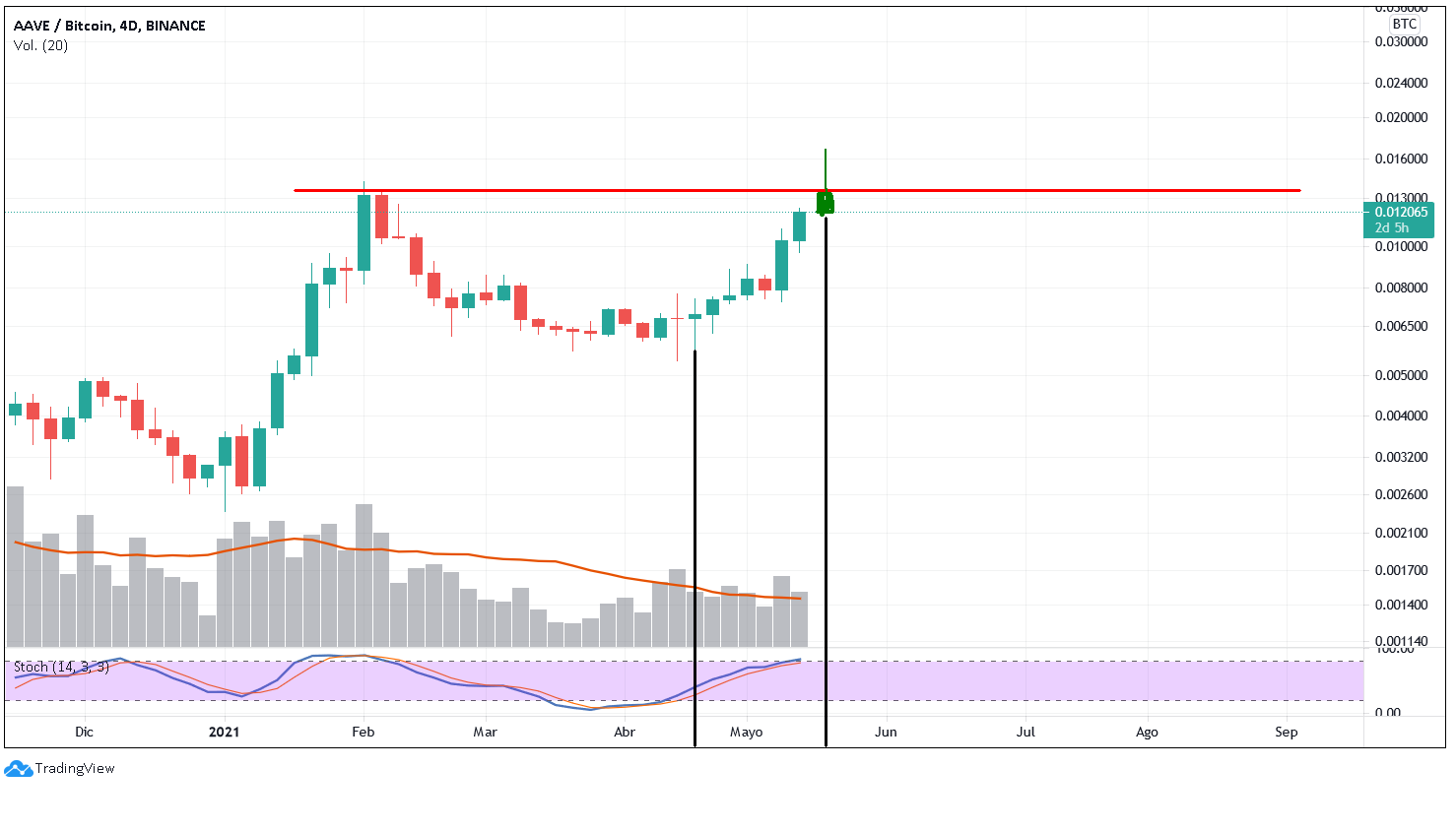
In 4-day candles, one can intuit in mid-April that AAVE will revalue against BTC and recommend holding it until it reaches its previous high, and then withdrawing with profits, so the sale of AAVE would occur practically a month after its recommendation.
In other words, the situation would be exploited that in that month it was more convenient to hold AAVE than BTC (because the AAVEBTC pair revalued) and the final result would be more BTC in our portfolio.
The idea of BTCARG is that one does not depend on third-party recommendations, but rather learns little by little to intuit it for oneself.
